classicnews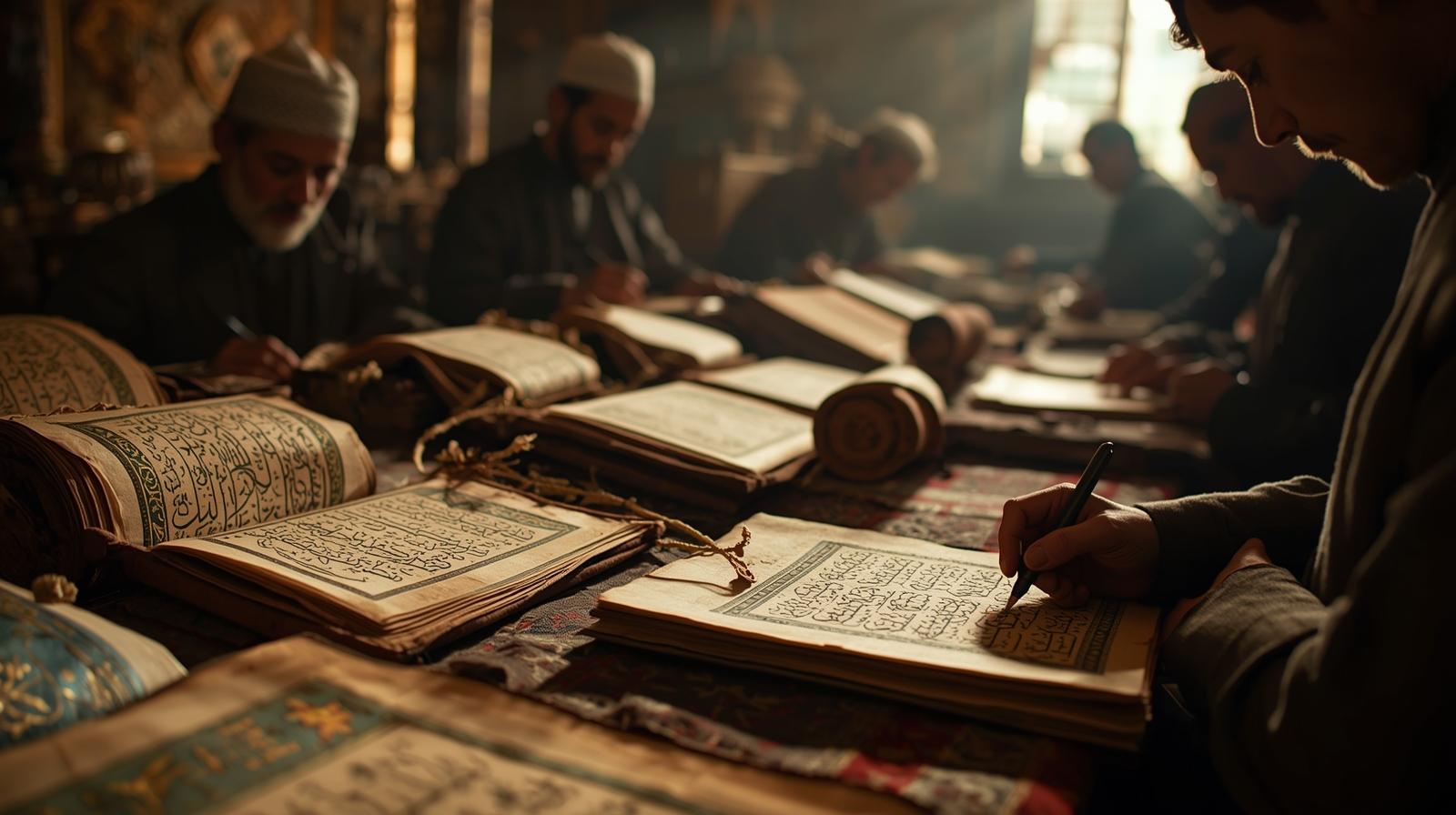
The Qur’an is the eternal miracle of Islam, a divine message revealed to Prophet Muhammad ﷺ over 23 years. Its preservation is a remarkable story of meticulous effort, divine guidance, and unwavering commitment by the companions (Sahabah). Understanding the compilation of the Qur’an is essential for appreciating the depth of Islamic heritage and the authenticity of its message.
Revelation and Early Preservation
The Qur’an was revealed gradually through the Angel Jibreel (Gabriel) to Prophet Muhammad ﷺ. During his lifetime, the Qur’an was preserved in three primary ways:
- Memorization (Hifz): Many companions memorized the verses immediately upon revelation. This oral tradition ensured that the Qur’an could be recalled accurately even if written materials were lost.
- Written Records: Verses were recorded on materials like parchment, bones, leather, and palm leaves. Trusted scribes, such as Zayd ibn Thabit, played a crucial role in documenting the revelations.
- Public Recitation: The Prophet ﷺ regularly recited the Qur’an publicly, which reinforced both memorization and accuracy.
These methods ensured that the Qur’an remained intact, even during a period when widespread writing materials were scarce.
Compilation During Abu Bakr’s Caliphate
After the Battle of Yamama, many companions who had memorized the Qur’an were martyred. Fearing the potential loss of the Qur’an, Caliph Abu Bakr (RA) commissioned a formal compilation.
- Zayd ibn Thabit was appointed to collect the Qur’an from all available sources, including written fragments and oral memorization.
- Each verse was cross-verified with multiple sources to ensure accuracy.
- The compiled Qur’an was preserved in a single manuscript, which was kept with Abu Bakr, and later passed to Caliph Umar (RA), and subsequently to Hafsa bint Umar (RA).
Standardization Under Uthman ibn Affan
As Islam expanded, differences in pronunciation and recitation appeared among distant communities. To preserve unity, Caliph Uthman ibn Affan (RA) standardized the Qur’anic text:
- He ordered multiple copies of the Qur’an to be made from Hafsa’s manuscript.
- These copies were sent to key Islamic regions, while other variant materials were destroyed to prevent confusion.
- This effort ensured that the Qur’an would remain uniform across the rapidly growing Islamic empire.
The version compiled under Uthman (RA) remains the standard Qur’an used by Muslims worldwide today.
The Divine Preservation
The Qur’an itself promises protection from corruption:
“Indeed, it is We who sent down the Qur’an and indeed, We will be its guardian.” (Surah Al-Hijr, 15:9)
The meticulous compilation and memorization, combined with divine safeguarding, have allowed the Qur’an to remain unchanged for over 1,400 years.
Conclusion
The compilation of the Qur’an is a testament to the devotion of the Prophet ﷺ and his companions, and a clear example of Allah’s promise of preservation. Its careful collection, memorization, and standardization ensure that Muslims today can access the same authentic message revealed over two millennia ago.
The story of the Qur’an’s compilation is not just historical—it is a reminder of the importance of preserving faith, knowledge, and guidance in every generation.